Happy Thanksgiving week. For many of you, this starts the busiest stretch of the year: holiday shoppers, seasonal staff, and buildings that sit quiet over a long weekend.
This week's news had a common thread close to home: networks and what's connected to them. Security cameras are often the largest group of devices on a business network, and the ones nobody has checked since the day they went in.
What's going on this week
Cranston Police shut down their network after a suspected intrusion. NBC 10 reported on November 22 that the department detected possible unauthorized access to a database, took its network offline as a precaution, and notified State Police and the FBI. Phones and radios kept working. In a November 23 follow-up, Dr. Timothy Henry of Rhode Island College noted that police departments "use the same type of equipment that small businesses, hospitals or other businesses use." (NBC 10; NBC 10 follow-up)
Why it matters: When something looks wrong, being able to disconnect quickly limits the damage, so know who at your business makes that call.
A Connecticut school district disconnected a server after a video surfaced online. On November 24, DysruptionHub reported that Manchester Public Schools took a server off its network after a TikTok video appeared to show someone accessing its files without authorization. (DysruptionHub)
Why it matters: Schools, churches, and offices often run staff, guests, and building systems on one network, and separating them limits how far a problem can spread.
FBI Boston is warning about holiday scams. On November 24, the FBI's Boston office said non-delivery and non-payment scams are the most common holiday schemes, citing figures of 121 Rhode Island victims losing more than $620,000. It also flagged gift card requests that appear to come from a boss. (FBI Boston)
Why it matters: A "can you grab some gift cards for me" text to a new seasonal employee is easy to fall for. Make "call back before you pay" a house rule.
Keeping your security cameras from being the weak spot
A security camera is really a small computer with a lens. Here's what I'd check:
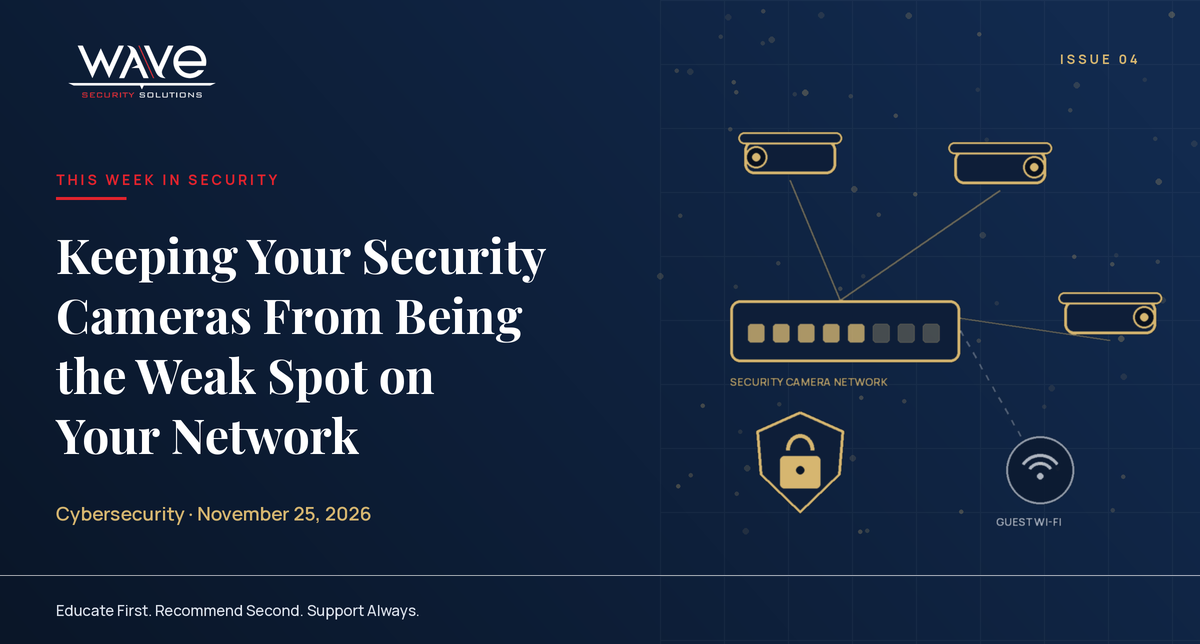
Give security cameras their own network. Keep your recorder and security cameras separate from guest Wi-Fi, the register, and office computers. If one side has a problem, the other isn't automatically exposed.
Close the open doors to the internet. Port forwarding on your router is the old way to watch from home, and a common way recorders get found. Use the manufacturer's secure app or a VPN instead.
Retire default and shared passwords. Everyone gets their own login, with two-factor sign-in where offered. Then review the user list and remove former employees, old vendors, and anyone you don't recognize.
Keep firmware current. Recorders, security cameras, and network switches all get updates. Schedule them for a quiet time.
Know what's on the network. Keep a simple list of every device and who manages it. Anything you can't update should come off.
Test before the long weekend. Confirm remote viewing works and offline alerts reach the right phone.
These are good habits, not a full cybersecurity program. If you handle card payments or sensitive records, or think something has already been compromised, bring in a dedicated cybersecurity specialist. If it's outside what we do, I'll tell you and point you to the right person.
If you run a business, a property, a school, or a church in Rhode Island, Massachusetts, or Connecticut and want a second set of eyes on how your security cameras sit on your network, I'm happy to take a look. No hard sell. Have a safe and happy Thanksgiving.
Real Security. Real People. Real Outcomes.
Educate First. Recommend Second. Support Always.